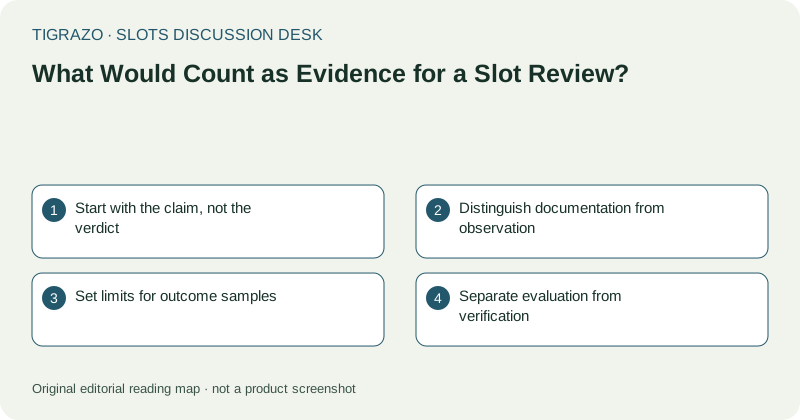
Start with the claim, not the verdict
A statement about symbol substitution needs the relevant rule. A statement about text readability needs an observation of the interface under identified conditions. A claim about configured RTP needs reliable configuration information. A claim about a rare event's probability needs more than a screenshot showing that it happened.
These are different evidence tasks. An engaging review should not allow strong evidence in one area to lend undeserved authority to claims in another.
Distinguish documentation from observation
Current rules can establish stated conditions, units, exclusions, and feature sequences. Direct interface observation can describe what was visible on a particular device and setting. Neither category is automatically sufficient for every technical claim, and discrepancies should be recorded rather than quietly reconciled by guesswork.
A review should identify relevant version information when available. If the same title can run with different settings, a general name does not guarantee that every reader sees the same configuration.
Set limits for outcome samples
A short sequence can illustrate that variation occurs. It cannot reliably establish long-run RTP or the probability of very rare awards. Even a large sample needs a defined collection method and an understanding of uncertainty before supporting numerical conclusions.
- How was the sample selected?
- Were unsuccessful sessions also included?
- Were settings constant and documented?
- Is the denominator known?
- Does the conclusion exceed the sample's scope?
Separate evaluation from verification
A reviewer may reasonably call an information panel crowded or a feature explanation clear, provided the judgement is presented as an assessment with reasons. Saying the game is mathematically generous is a different claim. It requires defined measures and cannot be established by enjoying a session.
In a hypothetical review, observing a legible stake control supports a statement about that control. It does not support a conclusion that the game is low risk. Clear controls and financial exposure are separate dimensions.
Apply an editorial evidence rule
Ask every reviewer to label statements as documented fact, bounded observation, interpretation, or unresolved question. These labels need not appear mechanically in every sentence, but the distinction should be apparent. Unsupported claims about guaranteed returns or exploitable timing should not be published as findings.
A strong review is not the one with the fewest caveats or the most dramatic result. It is the one whose conclusions stay within the evidence. That approach leaves room for useful design criticism while preventing confidence, entertainment value, or a handful of outcomes from becoming a substitute for verification.