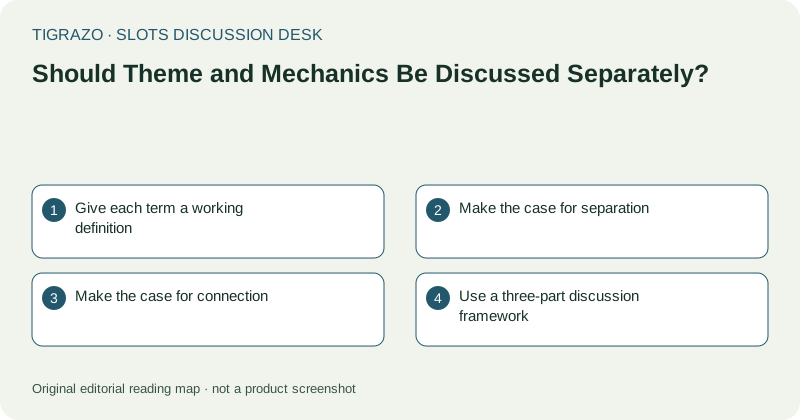
Give each term a working definition
Theme includes artwork, setting, characters, sound, and narrative framing. Mechanics include symbol functions, qualifying arrangements, feature triggers, award calculations, and documented state changes. An interface can blend them visually, but the distinction remains useful for analysis.
A treasure chest might be an ordinary paying symbol in one game and a feature trigger in another. Its illustrated identity does not establish its mathematical role. Rules, rather than thematic expectation, define what it does.
Make the case for separation
Separate sections allow a reader to appreciate visual craft without importing that judgement into cost or probability. They also let someone explain a payment system without repeatedly describing the same art direction. This helps when two games look different but share a general structural idea.
An editor should resist language suggesting that a friendly character makes losses gentler or a dramatic theme makes large prizes more likely. Presentation changes interpretation, not automatically the underlying mathematics.
Make the case for connection
Theme can make a mechanic easier to recognise. A clearly labelled collecting object may communicate accumulation, provided the actual rules agree. Consistent visual signals can help readers distinguish ordinary symbols from exceptions and understand when a feature starts or ends.
The connection becomes a design strength when it improves legibility. It becomes a source of confusion when narrative language implies progress that the rules do not preserve, or when decorative movement resembles a meaningful state change.
Use a three-part discussion framework
| Layer | Question |
|---|---|
| Theme | What mood or setting is presented? |
| Mechanics | What explicit rule determines this effect? |
| Interaction | Does the presentation clarify or obscure that rule? |
Consider a hypothetical animated map. If it only changes during an introductory sequence, it is presentation. If a stated rule carries progress between rounds, it represents a documented state. The picture alone cannot settle which interpretation is correct.
Allow mixed conclusions
A thoughtful contribution might praise coherent visual cues while finding the feature calculation difficult to follow. Another might explain the rules clearly but find the sound and animation tiring. These are compatible observations, not contradictory verdicts.
The editorial approach is therefore separation followed by connection. First establish what each layer does; then ask how they work together. This avoids both extremes: treating theme as irrelevant decoration, or letting an appealing story excuse unclear conditions. It also gives disagreement a precise subject, so readers can discuss design without making unsupported claims about returns.