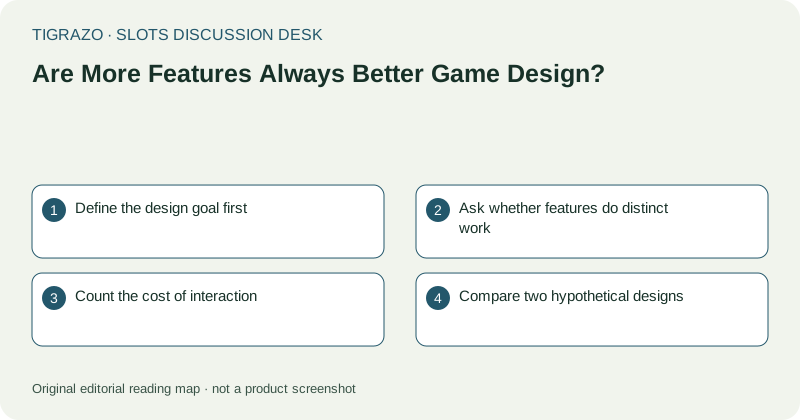
Define the design goal first
Better design needs a criterion. One reader may value a simple payment structure; another may enjoy understanding interacting systems. Neither preference establishes that a larger feature list is inherently superior. The evaluation should state whether it concerns readability, thematic coherence, pace, accessibility, or another specific quality.
Mathematical characteristics require their own evidence. Feature quantity alone does not reveal RTP, hit frequency, volatility, or the probability of any particular award.
Ask whether features do distinct work
A new feature can introduce a genuinely different decision-free game state, create visual variety, or explain a theme through mechanics. It can also rename an effect that is already present, making the rules longer without making the experience easier to understand.
Editors can invite readers to describe each feature in one sentence. If two descriptions are indistinguishable except for their names, that may suggest presentation variety rather than mechanical variety. Both can be discussed, but they should not be confused.
Count the cost of interaction
Complexity grows through interactions, not just the number of individual rules. A wild multiplier, a collector, and a feature-wide multiplier may each be simple alone while their combined order of operation remains difficult to follow. The rules should explain which values combine and when.
- Can the reader distinguish base rules from exceptions?
- Are feature transitions clearly signalled?
- Is the final award traceable to visible rules?
- Does important information remain readable during effects?
Compare two hypothetical designs
Imagine one game with a single clearly explained free-spin feature and another with five features whose prize units and interactions are poorly defined. The second has more content on a feature list, but the first may better serve a reader seeking understandable outcomes. This does not establish that simple games are always better.
Now imagine the five features are carefully separated, accessible, and coherent. The assessment changes because the criterion is information quality, not feature count. Hypothetical comparisons are most useful when they reveal the criterion rather than declare a universal winner.
Frame a discussion that allows disagreement
Ask which feature improves understanding or variety, and which creates avoidable confusion. Encourage examples tied to rules rather than unsupported claims that complexity increases winning opportunities. A feature can be engaging without being financially advantageous.
The editorial conclusion need not rank all designs. It can recognise that more features increase possibilities and explanatory demands at the same time. Good discussion identifies how well those demands are met, and leaves room for a reader to prefer less complexity without treating that preference as a lack of sophistication.