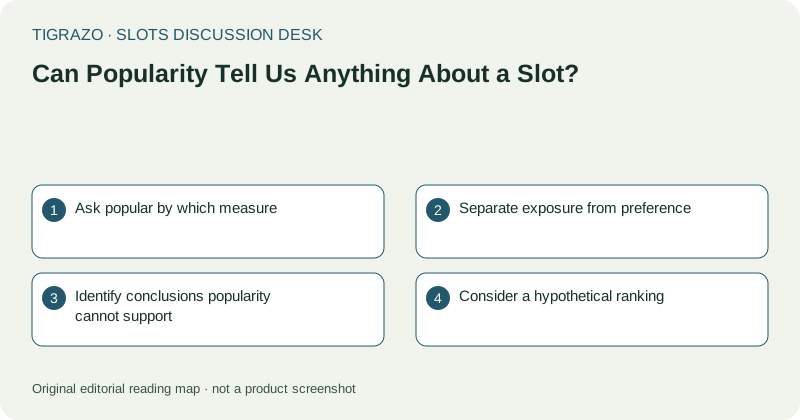
Ask popular by which measure
A ranking might reflect page views, launches, wager volume, search interest, or an editorial placement. Those quantities are not interchangeable. A game can receive many views because it is prominently displayed, while another attracts fewer people who each spend more time reading about it.
Without a defined period, population, and method, a popular label is a description with unclear scope. It should not be treated as a universal vote from all players.
Separate exposure from preference
Prominent placement can produce familiarity, and familiarity can produce more launches. A recognisable theme may attract attention before anyone has read the rules. Discussion can reasonably examine these pathways without pretending to know which one explains a particular ranking.
The key limitation is confounding: several causes can produce the same visible popularity result. A large audience therefore does not isolate good mechanics, clear information, or favourable mathematical characteristics as the reason.
Identify conclusions popularity cannot support
- It does not establish the configured RTP.
- It does not demonstrate a higher probability of your desired award.
- It does not prove that the rules are easy for every reader.
- It does not verify technical fairness or regulatory status.
- It does not show that the game suits a particular person's boundaries.
These questions require different evidence. Treating popularity as a substitute makes a discussion appear evidence-led while bypassing the evidence actually needed.
Consider a hypothetical ranking
Imagine two games receiving 1,000 and 500 launches during a week. If the first was displayed twice as prominently, the raw launch totals cannot establish a stronger underlying preference. Even launches per impression would answer only a narrower question about selection in that setting.
This hypothetical example shows why denominators matter. It is not an argument that the less-launched game is better. Reversing an unsupported conclusion does not improve the reasoning.
Use popularity as a starting question
A productive discussion might ask why a familiar mechanic is easy to explain, whether a theme encourages recognition, or how interface placement affects discovery. It should label these as questions or hypotheses rather than assert invisible motives.
Editors can welcome observations about recognisability while requiring a clear measurement for numerical claims. The best conclusion may be modest: popularity can indicate attention in a defined context, and can help identify topics worth examining. It cannot replace rules, configuration information, or a careful account of what a reader wants to understand. A widely noticed slot still deserves the same basic questions as an unfamiliar one.