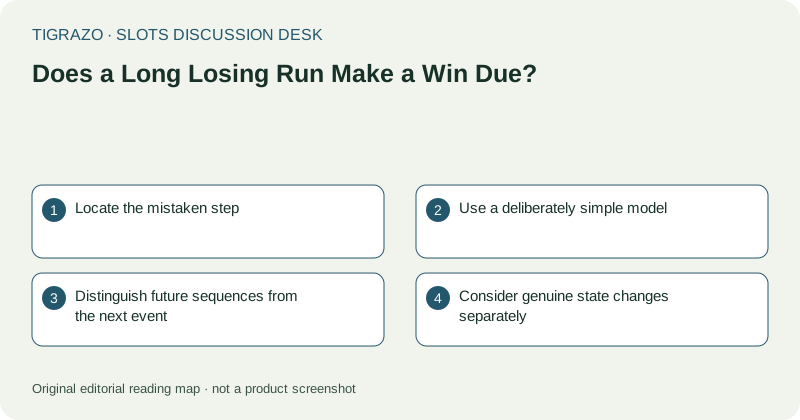
Locate the mistaken step
The common argument begins with a reasonable observation: a very long sequence of losses may be unlikely before play starts. It then makes an unsupported leap: because many losses have occurred, the next result must compensate. Independence means the second statement does not follow from the first.
The game does not need to restore balance within your session. A long-run mathematical average is not a schedule assigning a recovery point to each player or sequence of wagers.
Use a deliberately simple model
Suppose a hypothetical independent process has a one-in-four probability of a defined winning event on every trial. After ten losses, that next-trial probability remains one in four, assuming the conditions have not changed. The previous sequence may be surprising, but it is already part of the observed history.
This simplified model is not a claim about any slot's actual hit rate. It isolates the reasoning error. Also, a defined winning event must be specified: an award of any size and a net profit on a round are different events.
Distinguish future sequences from the next event
Before several trials, the chance of at least one occurrence across the group can differ from the chance on one trial. That does not mean the probability of each individual trial rises as earlier trials fail. Group probabilities and conditional next-trial probabilities answer different questions.
A useful forum contribution states which question it addresses. Otherwise, a correct calculation about a group can be misused to support an incorrect claim about a supposedly overdue next spin.
Consider genuine state changes separately
Some games have persistent meters or feature conditions that alter a documented state. These should be analysed using the actual rules. A visible counter reaching a threshold is different from assuming that losses secretly accumulate an entitlement to win.
- Identify the rule that creates a changing state.
- Describe the state before and after the event.
- Check which probabilities or awards the rule actually changes.
- Do not infer undocumented compensation from frustration.
Moderate claims without mocking people
The feeling that a win is due is understandable; treating it as evidence is the problem. An editor can challenge the inference while allowing discussion of how streaks affect attention and emotions. Claims about timing a recovery need support beyond personal recollection.
The practical boundary is simple: losses are not a reason to increase stakes, extend a session, or cross a spending limit. A discussion about probability should reduce pressure to chase, not supply more elaborate language for doing it.