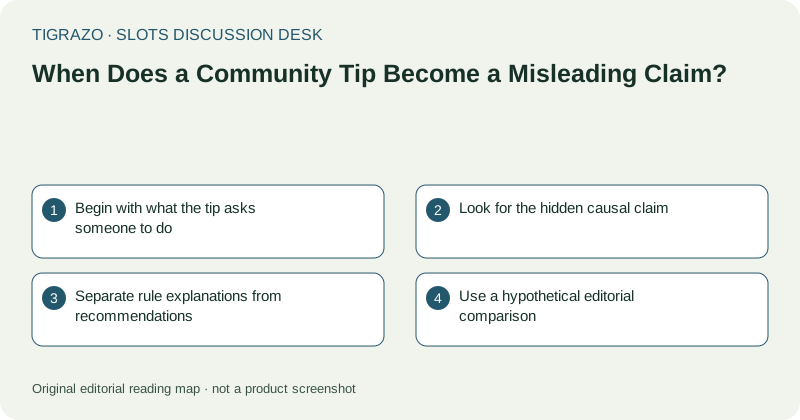
Begin with what the tip asks someone to do
Some tips improve information: open the paytable, confirm total stake, or record an error message. Others change gambling behaviour: raise the stake, continue after losses, or wait for a supposedly favourable time. The second group can increase exposure and therefore needs careful examination of its stated reason.
A tip is not harmless merely because it uses friendly language or includes a phrase about personal experience. Its practical effect matters as well as its tone.
Look for the hidden causal claim
Advice to play after a losing streak implies that the streak changes future chances. Advice to switch stakes after a near miss implies that the near miss reveals useful timing information. Under independent, unchanged conditions, those implications do not follow.
Ask the contributor to state the mechanism and its source. If the rule is not documented, a successful anecdote does not establish it. Many sequences can contain a favourable result after an arbitrary action without that action causing the result.
Separate rule explanations from recommendations
A documented optional setting may change a price or eligibility condition. Explaining that rule is not the same as recommending the setting or claiming it offers a profitable opportunity. The cost and scope need to be stated alongside the effect.
- Does the claim quote an actual condition accurately?
- Does it omit an added cost?
- Does it imply a guarantee where none exists?
- Does it encourage recovering losses through more spending?
Use a hypothetical editorial comparison
Consider the tip check whether prize values use total stake. It improves interpretation and makes no prediction. Now consider double the stake after five losses because a feature is close. The second statement introduces a timing claim and increases financial exposure. Without an explicit relevant rule, the loss count does not support it.
The distinction is not between positive and negative language. It is between verifiable information literacy and an unsupported assertion that an action controls uncertain outcomes.
Respond proportionately but clearly
An editor can preserve a useful observation while removing the misleading inference. A post may accurately describe a feature trigger yet incorrectly claim that a sequence reveals when it will happen again. Clarify the first and challenge the second.
Repeated guarantees, recovery systems, or pressure to ignore limits should not be treated as ordinary differences of opinion. A constructive community encourages questions, precise descriptions, and clear uncertainty. It does not need to provide a platform for advice that turns memorable outcomes into promises or asks readers to spend more to validate a theory.