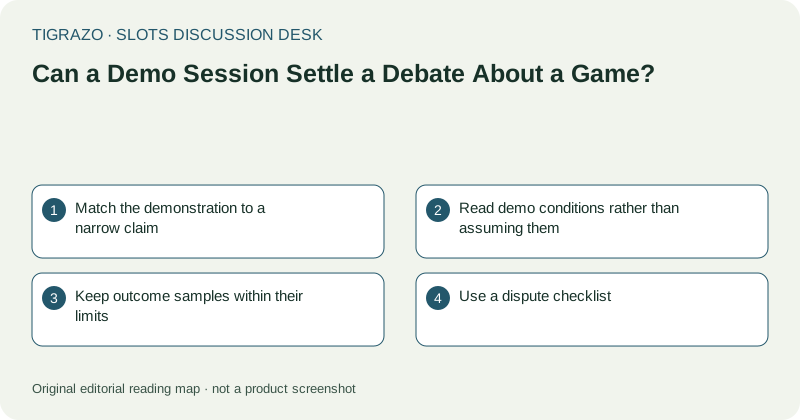
Match the demonstration to a narrow claim
If the dispute concerns where an information control appears, a clearly identified demonstration can help. If it concerns whether a specific animation follows a trigger, a recorded example may illustrate that sequence. These are bounded observations about presentation under stated conditions.
A demonstration is less decisive when the disputed claim concerns current real-money eligibility, a different configuration, or the probability of an event. Its usefulness depends on whether the relevant conditions actually match.
Read demo conditions rather than assuming them
Demonstration balances have no cash value unless an explicit separate arrangement says otherwise; ordinary demo credits are simulated. Demo conditions may differ from real-money conditions, and similar-looking screens do not establish identical configuration. Read the applicable information and record what remains unknown.
Do not assume every difference exists, either. The appropriate position is verification: identify the conditions that are documented rather than asserting identity or difference without evidence.
Keep outcome samples within their limits
A demo session produces a sequence, not a complete map of the distribution. A run with several features does not establish that features are generally frequent. A run without them does not establish that a trigger is broken or permanently absent.
Consider a hypothetical argument based on one hundred simulated rounds. Even if the count is accurate, a rare event may not appear at all. Its absence from that sample does not prove that the rules exclude it. Conversely, one appearance does not reveal its true probability.
Use a dispute checklist
- State the exact claim in one sentence.
- Identify the game version and settings, where available.
- Explain whether the claim concerns rules, presentation, or probability.
- Say what the demonstration directly shows.
- List the conclusions it cannot establish.
For a rules dispute, the current rule text should remain central. A demonstration can help interpret it, but a remembered animation should not silently replace explicit conditions.
Recognise when the debate should remain open
An editor can conclude that the available demo does not settle a configuration question. That is preferable to asking readers to spend money conducting an informal test. Technical disputes should use appropriate records and support channels rather than repeated paid experiments.
The strongest contribution is often modest: this footage illustrates the sequence under these conditions, while the mathematical or real-money claim remains unverified. A demo is useful evidence when its scope is clear. It becomes misleading when simulated experience is promoted into certainty about every version, every session, or future outcomes.