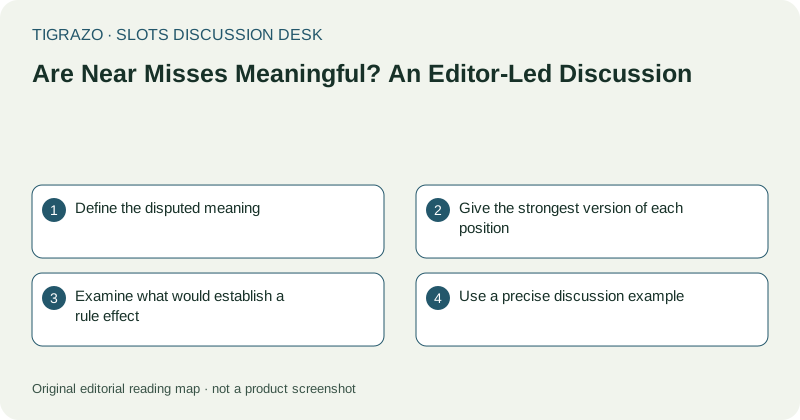
Define the disputed meaning
Meaningful can refer to several things. A near miss may matter psychologically because it attracts attention or makes a feature easy to imagine. It may matter aesthetically because the presentation emphasises an almost-completed arrangement. Neither meaning establishes a change in the probability of a future independently determined spin.
For this discussion, distinguish the experience of closeness from the mathematical conditions for an award. A combination either qualifies under the rules or it does not; visual proximity alone is not an additional payment category.
Give the strongest version of each position
One position says near misses deserve discussion because presentation affects how people interpret play. That is a useful design question. Another says a near miss has no predictive significance for an independent next spin. That is a useful probability statement. These positions need not conflict.
The disagreement becomes misleading when an observation about emotional impact is treated as evidence that a win is approaching. A vivid result can change attention without changing the next round's odds.
Examine what would establish a rule effect
Some games contain explicitly described persistent states, counters, or feature progress. If a result changes such a state, the change should be established through the rules rather than inferred from a nearly matching picture. The relevant question is what state changed, not how close the animation looked.
- Was the displayed arrangement a completed recorded result?
- Did the rules award progress or another persistent effect?
- Is the next round independently determined under unchanged conditions?
- Is the claim about feelings, current state, or future probability?
Use a precise discussion example
Consider a hypothetical game requiring three special symbols to trigger a feature. Two such symbols appear and no rule awards progress for them. The result does not qualify for that feature. Describing it as visually close is reasonable; describing it as evidence that a trigger is now due adds a claim the example does not support.
Repeated screenshots of similar results would document repeated appearances, not demonstrate a compensating mechanism. Frequency questions require a defined sample and suitable evidence, not a collection chosen because it looks striking.
Set a useful editorial boundary
A constructive discussion can ask how animation, sound, and symbol placement shape perceived closeness. It should challenge claims that near misses reveal timing opportunities or justify chasing a feature. Participants should identify which kind of meaning they intend before debating it.
The resulting conclusion can hold both ideas at once: near misses may be influential experiences, while still providing no forecast of the next independent outcome. That distinction keeps a design conversation from becoming a prediction claim.