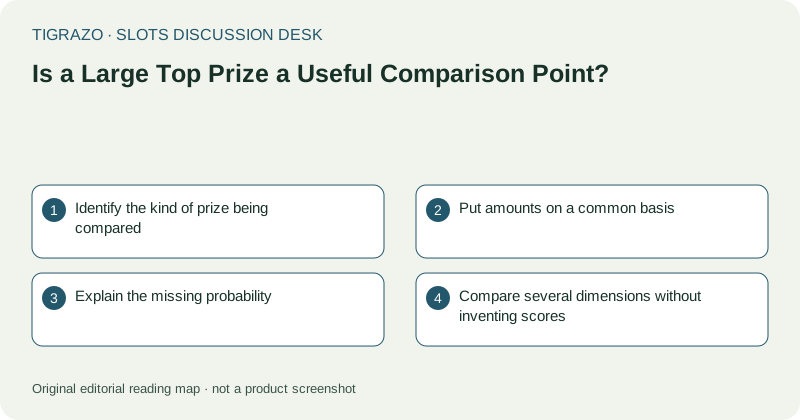
Identify the kind of prize being compared
A maximum win cap, a fixed jackpot, and a progressive jackpot are different concepts. A maximum may limit the total award from a defined round or feature. A fixed prize has a specified amount or multiplier subject to its rules. A progressive amount can change according to the relevant system.
Do not compare the labels as though they all describe the same event. Establish what qualifies, what is included, and whether the displayed figure has conditions.
Put amounts on a common basis
Currency figures depend on stake and sometimes denomination. Multipliers require a defined stake unit. A prize listed as times line stake cannot be compared directly with one listed as times total stake without translation.
In a hypothetical comparison, a maximum of 2,000 times a 0.50-unit total stake equals 1,000 units. A maximum of 3,000 times a 0.20-unit total stake equals 600 units. The larger multiplier and the larger currency amount point in different directions. Neither calculation reveals likelihood.
Explain the missing probability
A ceiling describes the upper endpoint of an outcome range, not how often outcomes near it occur. Two games can share a maximum while distributing awards very differently. Conversely, different maximums do not tell you which game has the higher RTP or hit frequency.
Without the relevant probabilities and rules, the discussion must leave those questions unanswered. A dramatic number is not evidence that the maximum is attainable within an ordinary session or that pursuing it is financially sensible.
Compare several dimensions without inventing scores
| Dimension | Useful question |
|---|---|
| Ceiling | What exactly is capped? |
| Eligibility | Which settings and events qualify? |
| Unit | Currency, credits, or which stake multiple? |
| Distribution | What information is actually available? |
| Clarity | Can a reader explain the conditions? |
A table like this organises evidence without pretending to calculate an overall quality score. An unknown cell should stay unknown rather than receive a favourable assumption.
Keep the conclusion narrow
Editors can allow comparisons of stated top prizes while challenging phrases such as better value when only a ceiling has been examined. Readers should be able to see exactly what was compared and what was not.
The useful result is a dimensional comparison, not a recommendation to chase the largest number. A top prize can answer how high a defined award may go. It cannot, by itself, answer how a game is likely to feel, what a session will cost, or whether its rules fit a reader's needs.