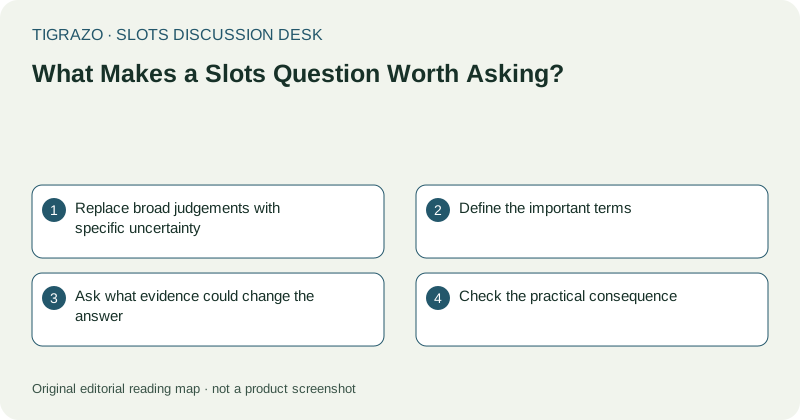
Replace broad judgements with specific uncertainty
Is this game good asks several questions at once. It may concern legibility, payment structure, mathematical characteristics, theme, or personal comfort. A useful discussion begins by choosing one dimension. For example, does this rule require consecutive reels is narrower and more answerable.
Specificity also makes disagreement productive. Contributors can examine the same condition instead of offering unrelated verdicts that appear to conflict only because they address different concerns.
Define the important terms
Words such as win, hit, return, stake, and feature can carry different meanings. A round that pays less than its stake may be an award event but still a net loss. A percentage called return may refer to a theoretical expectation rather than one person's observed balance.
State the intended meaning within the question. This is especially important for numerical discussions, where precise arithmetic can still answer the wrong question if the units or events are undefined.
Ask what evidence could change the answer
A rules question may be resolved by current rule text. A device question may need identified browser and screen conditions. A claim about probability may require information unavailable from casual observation. Knowing the evidence requirement prevents endless argument over anecdotes.
- What exactly is unknown?
- Which version or settings matter?
- What information would resolve it?
- What result would show the initial assumption was wrong?
Check the practical consequence
A good question often improves understanding or reduces confusion. Where is the total stake displayed can prevent a unit mistake. What conditions apply to this prize can expose an incomplete promotional description. Neither requires predicting a future result.
By contrast, when will it pay invites an answer the available evidence cannot provide for independent spins. Reframe it as what does the game disclose about its outcome distribution. The revised question may still have missing information, but it no longer assumes a timetable exists.
Allow unresolved answers to count
An editorial forum should not reward confident invention over a careful statement that a configuration is unknown. A question can be worthwhile even when the current evidence is insufficient. The discussion can identify precisely what would be needed and stop there.
The final test is whether the question leaves readers better equipped to interpret information without encouraging paid experiments, chasing, or unsupported certainty. Simple, bounded questions often do that best. They turn curiosity into a shared reading task and give the community a way to distinguish an explanation from a story that merely sounds persuasive.